Problem 47

By Supreme2023-03-15
Problem Statement :
Write a C program using global variable, static variable
Code:
#include <stdio.h>
void func1();
void func2();
int global_var = 0;
int main() {
//47. Write a C program using global variable, static variable.
func1();
func1();
return 0;
}
void func1() {
static int static_var = 0;
global_var++;
static_var++;
printf("\nIn func1, global_var = %d, static_var = %d\n", global_var, static_var);
}
void func2() {
printf("\nIn func2, global_var = %d\n", global_var);
}
Description :
- This program demonstrates the use of global and static variables in a C program.
- The program includes the header file
stdio.h, which provides input/output functions. - The program declares two functions
func1andfunc2, as well as a global variableglobal_varinitialized to 0. - The
mainfunction is defined, which does the following: a. Calls thefunc1function twice. b. Returns 0 to the operating system. - The
func1function is defined, which does the following: a. Defines a static variablestatic_varinitialized to 0. Static variables retain their value between function calls. b. Increments the global variableglobal_varandstatic_var. c. Prints the current values ofglobal_varandstatic_varto the console. - The
func2function is defined, which does the following: a. Prints the current value of the global variableglobal_varto the console. - When the program is run, the
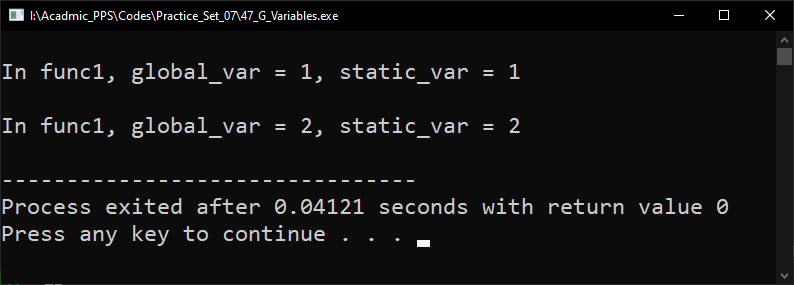
mainfunction is called, which in turn callsfunc1twice.func1increments the value of the global variableglobal_varand the static variablestatic_vareach time it is called, and prints the values to the console. Sincestatic_varis a static variable, it retains its value between function calls. - The output of the program shows the values of
global_varandstatic_varafter each call tofunc1.
Output Image: